

Ines Jimm
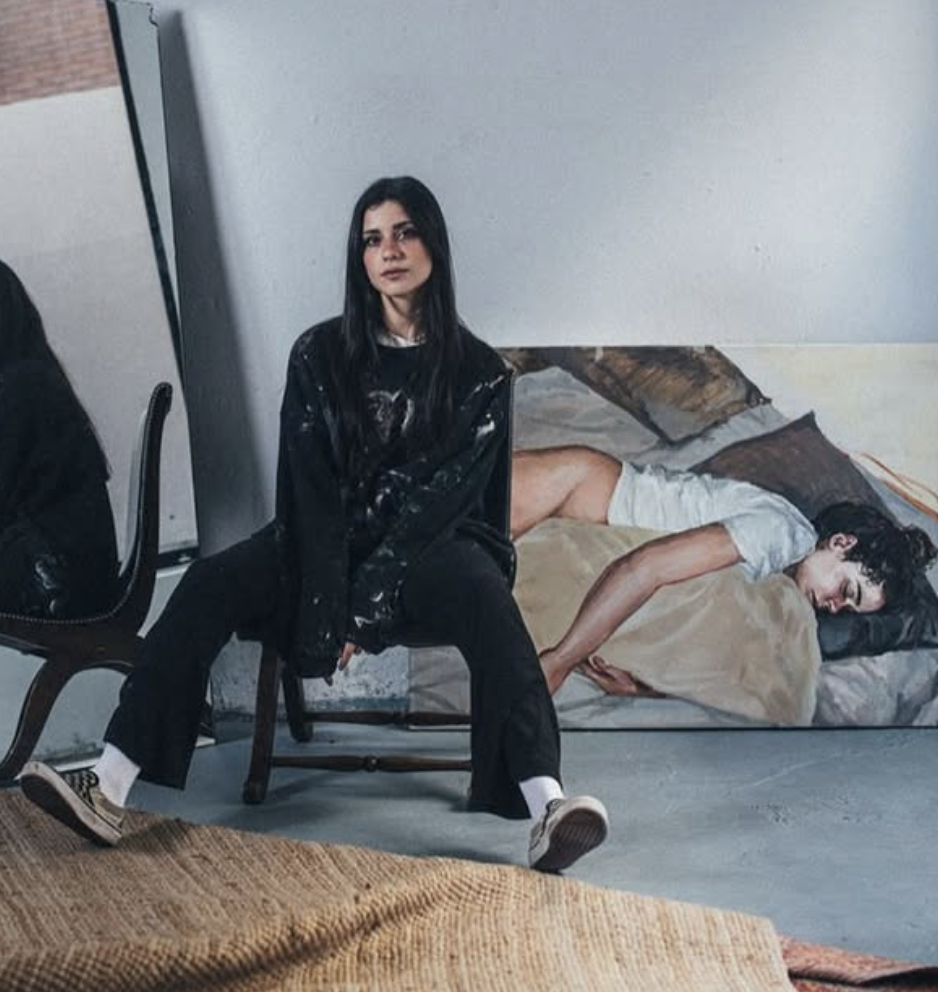
From an early age, Inés Jimm understood she wanted to be an artist—not as an abstract desire but as a radical certainty. However, life often led her away from that path. Frequent moves between cities and schools made adaptation a survival mechanism. Each transition required her to be "the new one," to observe, to adapt, and to mold her personality to be accepted. Over time, this capacity for adaptability became second nature, a skill honed to such perfection that it gradually erased parts of her true self.
This disconnection deepened through years of public-facing work. Being repeatedly inserted into unfamiliar contexts taught her the importance placed on first impressions and the implicit pressure to present a coherent, likeable version of herself. As a woman, this pressure was compounded by the expectation to be desirable, physically polished yet non-threatening. It reached the point where she altered even her tone of voice in order to be perceived as more acceptable. These cumulative adjustments led her to reflect more broadly on how we all, to varying degrees, become products shaped for external consumption. Her own circumstances merely amplified what is, in essence, a universal experience: the multiplicity of selves we enact depending on our social context—among friends, strangers, family, colleagues, or online. This realization gradually led her away from performance and back toward painting. When she returned, she did so carrying both a sense of loss and a quiet urgency to recover something true.
It was during this period of personal disorientation—brought on by depression and the collapse of a self that had long been shaped by the reflections of others—that sleep emerged for Jimm not merely as a subject, but as a profound conceptual space. She became obsessed with it because it offered the only window of time in which she could be certain of who she was. Sleep was the one moment she could not perform, could not tailor herself to expectations, and therefore could begin to rediscover herself. From that point forward, her fascination with sleep became the foundation of her painting practice. Through the vulnerable and sincere exposure of the sleeping body, she has come to know herself again—by embracing, in others, the same unguarded state she once feared. Sleep represents a state in which action, performance, and control cease. In contrast to society’s relentless demand for self-curation and productivity, it offers a rare form of unfiltered existence. To sleep is to be without mask, without pose, without intention—and in a culture defined by doing, producing, and visibility, that alone becomes radical.
Jimm began painting people asleep, driven by a desire to capture this moment of grace, freedom, and unobserved presence. Sleep functions as both refuge and mirror—revealing trust, surrender, and the dissolution of control. Initially, she painted only those with whom she shared a strong emotional bond, as a gesture of care. Over time, however, this offering expanded. Today, she also paints strangers, guided by the same principle: to offer them, too, a space in which to simply be.
In her practice, sleep is not an escape. It is not a dreamscape. She does not paint dreams—she paints the act of sleeping itself. The precise moment when the body releases and the soul becomes visible. A sleeping body cannot lie or strategize—it simply exists. And in an era of hyper-performance, that kind of presence is profoundly rare. Art, then, becomes a site to restore that right to simply be.
Sleep also represents a fissure within capitalist logic. It is unproductive time, a space that cannot be commodified. In a system where bodies are expected to be useful, measurable, and always visible, sleep becomes a quiet act of disobedience. To paint sleeping bodies is to highlight presence without performance—a body that offers nothing, proves nothing, and yet remains worthy of depiction.
Technically, Jimm’s work is figurative, but it inhabits a threshold. Brushwork is as essential as form. Some areas are meticulously rendered, others remain unfinished—gestures in suspension. Traces of the underlying sketch remain visible, as do raw patches and stains. This is not merely aesthetic—it is political. It affirms that what is unresolved has value. Her compositions express the tension
The Last Breath of Wakefulness
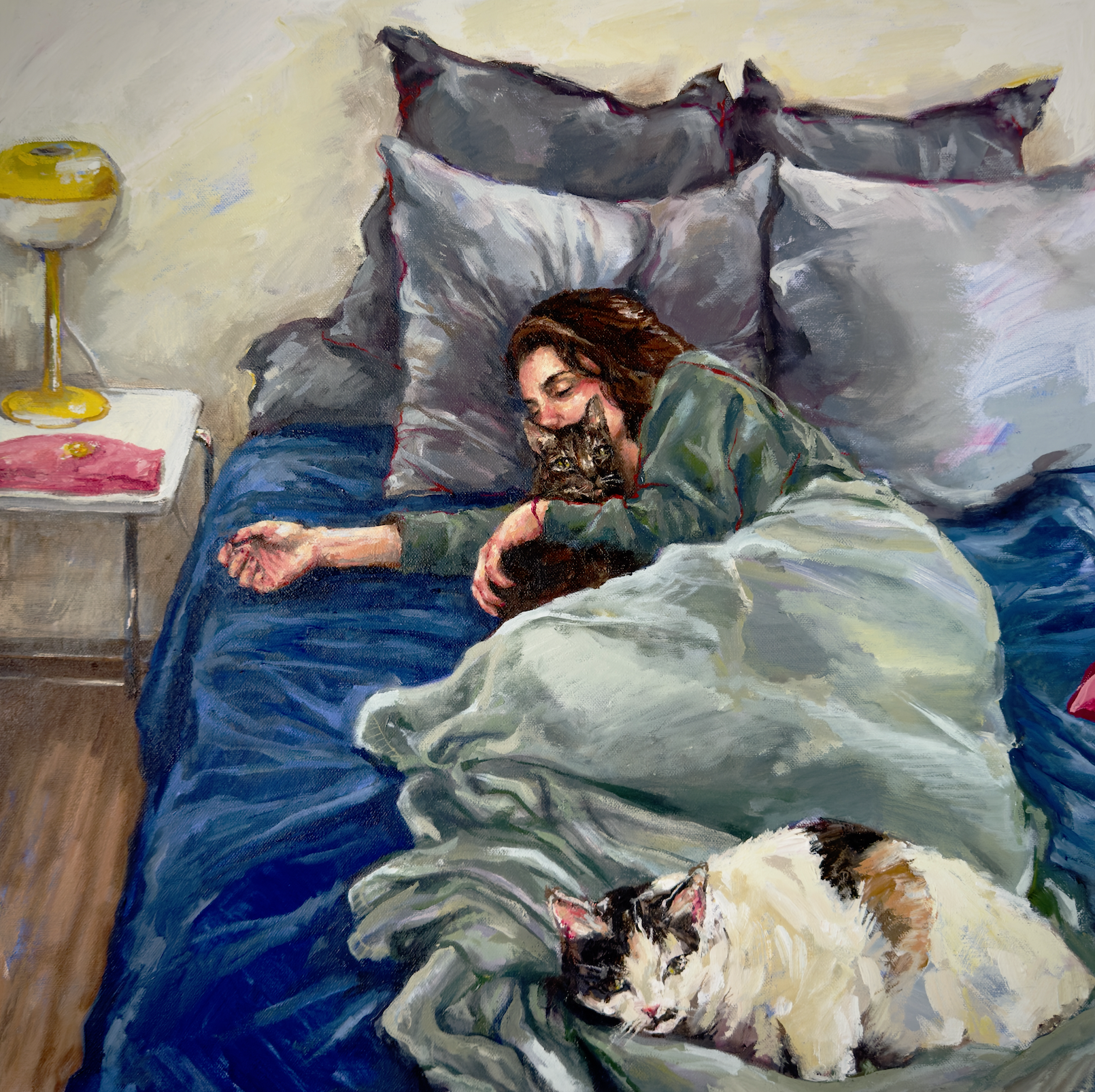
Oil on canvas
24” x24”
$1700